
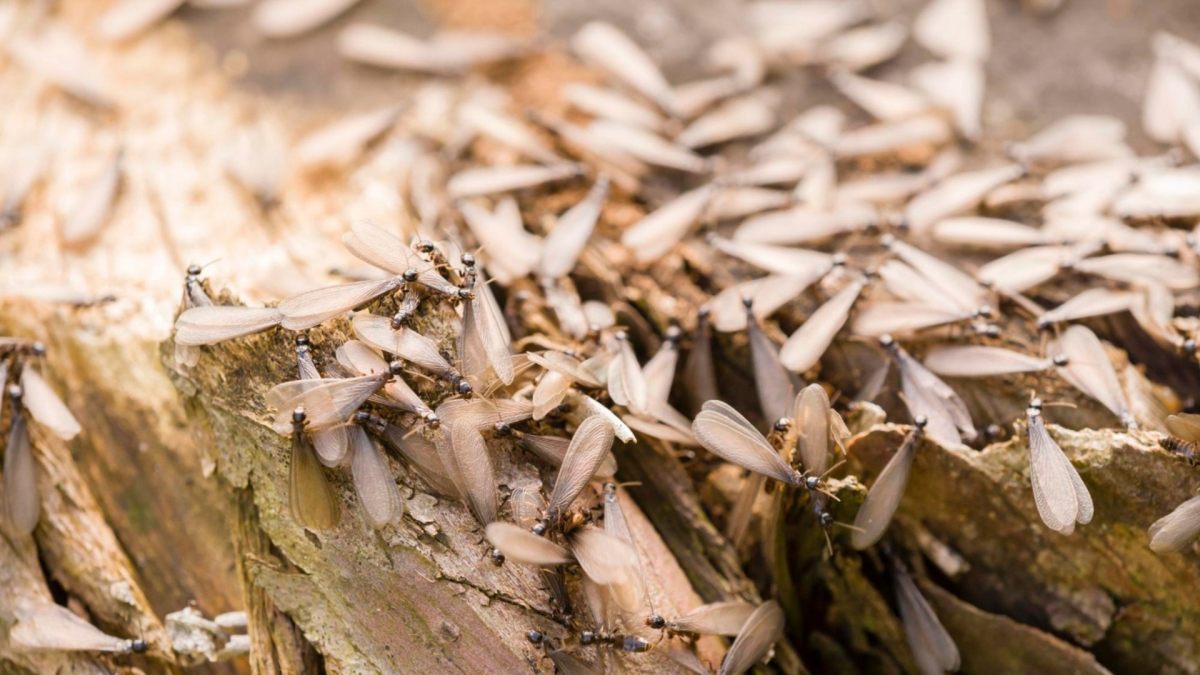
Seeing a cloud of winged insects pour out of a wall or swirl around a sunny window on a warm spring afternoon is unsettling. If that happened at your home in Harnett County or the Fort Liberty area this spring, there's a strong chance you witnessed a termite swarm. A swarm is the one moment termites make themselves easy to see, and it almost always means a colony is already established nearby.
The good news is that a swarm gives you information, and information you can act on. The key is knowing what you're looking at and what to do next.
Quick Summary
- A termite swarm is a group of winged reproductive termites (called swarmers) leaving an established colony to start new ones.
- In North Carolina, swarms usually happen on warm, humid spring days, often within a day or two of rain.
- The swarmers themselves don't eat your house, but their presence signals an active colony that can.
- Discarded wings on windowsills, near doors, and in spider webs are one of the most reliable clues.
- The right response is a professional inspection, not a can of spray. You can reach out to us here to schedule one.
What Is a Termite Swarm?
A termite colony spends most of its life hidden underground or inside wood, quietly feeding out of sight. Once that colony matures, it produces a batch of winged reproductive termites whose only job is to leave, pair off, and start new colonies. That mass departure is a swarm.
Swarmers are drawn to light, which is why you'll often find them at windows, sliding doors, and light fixtures. They're weak fliers, so they don't travel far. After a short flight they shed their wings, which is why a pile of identical, teardrop-shaped wings is such a telling sign.
If a swarm happens indoors, it points to a colony inside or directly beneath your home. A swarm outdoors near your foundation is still worth taking seriously, because the colony that produced it may already be feeding on nearby structural wood.
What Do Termite Swarmers Look Like?
Knowing what you're actually looking at helps you respond correctly instead of guessing. Eastern subterranean termite swarmers are small, usually around a quarter to three-eighths of an inch long including the wings. Their bodies are dark brown to nearly black, and their four wings are pale, translucent, and noticeably longer than the body.
Up close, a swarmer has a straight, uniform body with no obvious waist, and short, straight antennae. The wings are the giveaway: all four are roughly the same length and shed easily, which is why you'll often find the wings long after the insects themselves are gone. If you find a scattering of matched, teardrop-shaped wings on a windowsill with no insects attached, that alone is worth an inspection.
When Do Termites Swarm in North Carolina?
Eastern subterranean termites are the most common species across our part of the state, and they typically swarm in spring. Warm temperatures, higher humidity, and recent rainfall are the usual triggers. In Harnett County and the surrounding area, that means late winter through late spring is prime swarm season.
Timing can vary year to year with the weather, and a mild, wet spring can bring swarms earlier or spread them out. A second, smaller wave of activity is also possible in the fall. The takeaway is simple: if you see swarmers in the warmer months, treat it as a live signal rather than a fluke.
Subterranean termites tend to swarm during the day, often in the late morning or early afternoon, which is one more clue that separates them from certain other insects. It's also worth knowing that colonies don't respect property lines. If a neighbor has reported swarms, or if your street is seeing them, the soil conditions that favor termites are likely present across the area, and your home is worth checking even if you haven't spotted swarmers yourself.
Flying Termites vs. Flying Ants: How to Tell the Difference
Flying ants swarm too, and homeowners often confuse the two. The distinction matters because one calls for a termite inspection and the other usually doesn't. Here's a quick side-by-side:
|
Feature |
Termite Swarmer |
Flying Ant |
|
Waist |
Straight, no pinch |
Narrow, pinched waist |
|
Antennae |
Straight, beaded |
Bent (elbowed) |
|
Wings |
Four equal-length wings |
Front wings longer than back |
|
Wing shedding |
Sheds wings easily, leaves piles |
Keeps wings longer |
If you still aren't sure, save a few of the insects (or a couple of the shed wings) in a small bag or piece of tape. A technician can confirm the identification during an inspection, and correct identification is the first step toward the right plan.
What to Do the Moment You See a Swarm
A swarm feels like an emergency, but a calm, orderly response serves you better than panic. Take these steps:
- Collect a sample. Tape a few swarmers or wings to an index card so they can be identified.
- Note the location. Where did they emerge? Indoors near a wall or fixture is more urgent than a distant spot in the yard.
- Vacuum up the visible insects. This clears the mess but does nothing to the colony.
- Leave the wood alone. Don't drill, dig, or probe suspected areas, since disturbing them can complicate treatment.
- Schedule a professional inspection. This is the step that actually addresses the problem.
What Not to Do
Reaching for a hardware-store spray is the most common mistake, and it usually makes things worse. Most retail products are repellent based, which scatters activity rather than eliminating the colony. That can push termites deeper into a structure and make professional treatment more involved later.
It's also tempting to assume the problem is gone once the swarm ends and the visible insects disappear. It isn't. The swarmers you saw were only the reproductive members leaving; the colony that produced them is still there, still feeding.
Why a Swarm Is a Warning, Not the Problem Itself
Think of a swarm the way you'd think of smoke. The smoke isn't the fire, but it tells you a fire is burning somewhere you can't see. Termite damage develops slowly and quietly, often for years, before anything visible appears. A swarm is one of the few early alarms you'll ever get.
Acting on that alarm early is far less costly than repairing structural damage down the road. That's especially true in the western Harnett County growth corridor, where newer homes on slabs and in crawl spaces are still worth protecting from day one.
How Long Does a Termite Swarm Last?
An individual swarm is usually brief, often lasting anywhere from a few minutes to under an hour, sometimes a bit longer on the right day. Because swarmers are weak fliers drawn to light, an indoor swarm can look dramatic and then be over quickly, leaving little behind but a pile of wings.
Don't let the short duration fool you into thinking the situation resolved itself. The same colony can produce multiple swarms over a season, and even a single event confirms a mature colony is present. The brief show is the visible tip of a problem that continues below the surface.
What Attracts Termites to Your Home?
Termites follow moisture and accessible wood, so a few common conditions make a home more inviting than it needs to be. Reducing them won't replace professional protection, but it lowers your risk and supports whatever treatment is in place. The usual attractants include:
- Excess moisture in and around the foundation, including a damp crawl space, poor drainage, and downspouts that dump water at the base of the house.
- Wood-to-soil contact, such as deck posts, fence sections, porch supports, and firewood stacked against the house.
- Mulch piled deep against the foundation, which holds moisture right where termites travel.
- Leaky plumbing, condensation, and any chronic wet spot that keeps wood soft.
Because moisture is the common thread, managing it is one of the most effective long-term defenses. Controlling dampness under the house through moisture control makes the environment far less hospitable to subterranean termites.
How Holloman Handles Termites
We've been protecting homes and businesses across Harnett County since 1954, and termite work is at the core of what we do. When you call after a swarm, we start with a thorough inspection to confirm what's happening and where. From there, we recommend a clear plan, whether that's a liquid soil barrier, in-ground bait stations, or a combination suited to your home and situation.
We keep the process straightforward on purpose. You'll get an honest assessment of what you actually need, not a pile of pressure. Because Steve, Cole, and Drew are in the business every day and turnover is low, you tend to see the same familiar faces on each visit. We're also proud to be 5-star rated on Google and to have been voted Best Pest Control in Harnett County in 2025 by the Daily Record.
A few practical points customers appreciate:
- No long-term contracts. We keep your business through performance and consistency, not restrictive paperwork.
- Monthly payment options and service bundles, including our Advanced Protection Bundle that combines termite protection with quarterly general pest control.
- WDI (Wood Destroying Insect) reports for real estate transactions, plus pre-treatment for new construction if you're building in the area.
You can learn more on our termite control page, or simply reach out and we'll take it from there.
Frequently Asked Questions
Do flying termites mean my house is already damaged?
Not necessarily, but they do mean a colony is active nearby. Damage depends on how long the colony has been feeding and where. An inspection is the only way to know the extent, which is why prompt scheduling matters.
Will the swarmers damage my home?
The winged swarmers themselves don't eat wood. Their role is reproduction. The concern is the established colony they came from, along with any new colonies they may start.
I vacuumed them up and they're gone. Am I fine now?
Removing the visible swarmers only clears the surface. The colony remains underground or inside the structure and will keep feeding until it's treated. A swarm that stops on its own is not a solved problem.
How fast should I act after seeing a swarm?
Sooner is better. Termite damage accumulates over time, so the earlier a professional confirms and addresses the activity, the less risk to your home. There's no benefit to waiting.
Do you offer termite protection for new construction in the growth corridor?
Yes. We work with homeowners and builders on pre-treatment throughout the Lillington, Angier, Anderson Creek, and Spout Springs area. If you're building, contact us early so protection is in place from the start.
What time of year do termites swarm in North Carolina?
Eastern subterranean termites, the most common species here, usually swarm in spring on warm, humid days, frequently after rain. Exact timing shifts with the weather each year, and a lighter second wave is possible in the fall.
Are termite swarmers attracted to light?
Yes. Swarmers gravitate toward light, which is why you'll often see them at windows, glass doors, and light fixtures. That's also why indoor swarms tend to cluster in those spots and leave wings behind on windowsills.
Can I treat a termite swarm with store-bought spray?
Retail sprays might knock down the visible swarmers, but they don't reach the colony and can push activity deeper into the structure. Most are repellent based, which scatters termites rather than eliminating them. A professional treatment is what addresses the actual colony.
The Bottom Line
A termite swarm is your home's way of tipping you off to something you'd otherwise never see. It isn't a reason to panic, but it is a reason to act. Collect a sample, skip the store-bought spray, and get a professional set of eyes on the situation.
If you've spotted flying termites or shed wings this spring, we're ready to help. Send Us a Message or Call Now: (910) 892-7438.