
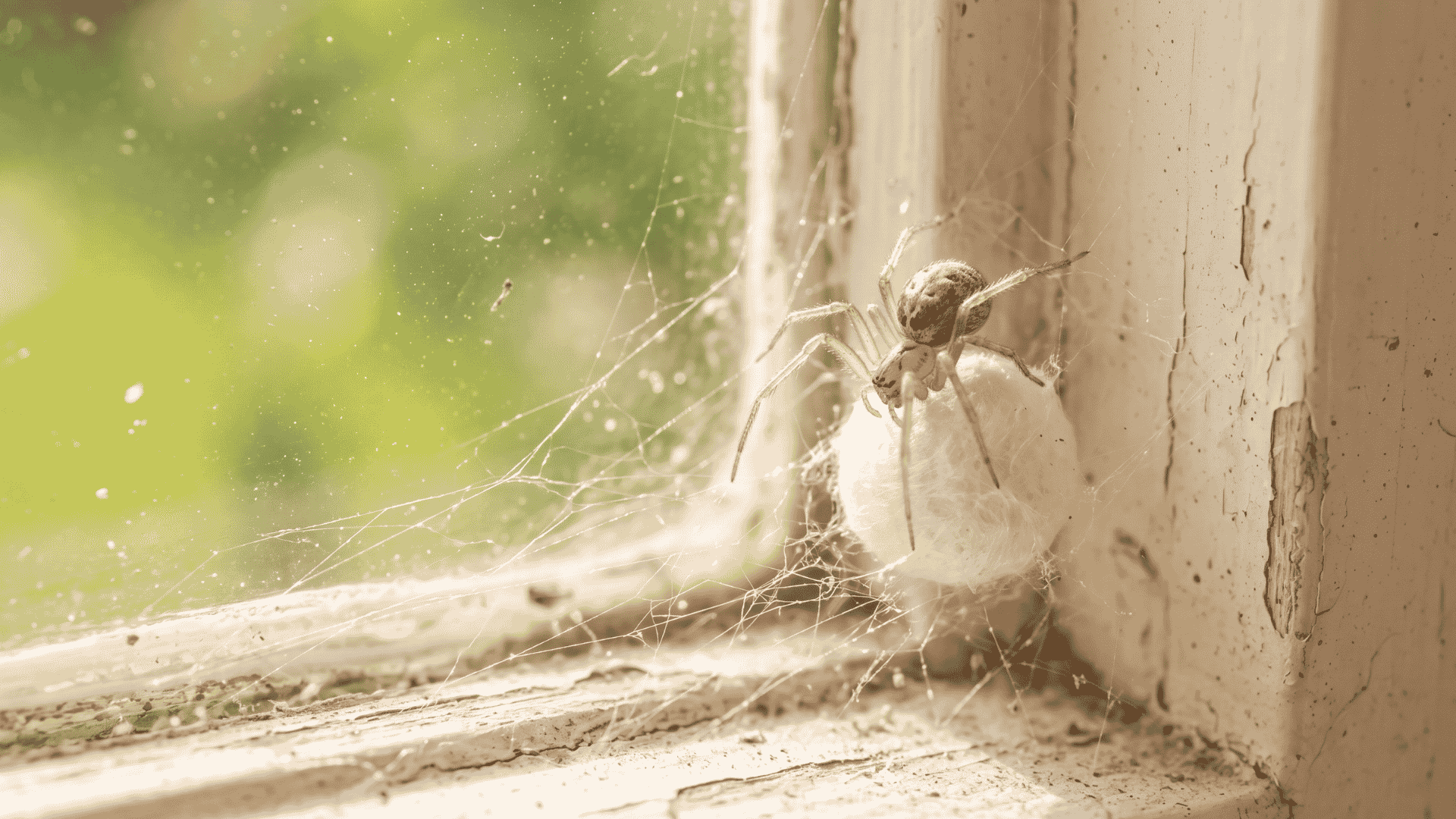
Finding a strange little silk ball in the corner of your garage can stop you cold. Most of the time it's a spider egg sac, and most of the time it belongs to a harmless spider. But a few of them deserve respect, and knowing which is which tells you whether to grab the vacuum or pick up the phone.
This guide covers what spider eggs look like in North Carolina, where to look for them, how to remove them safely and how to keep new ones from showing up next season.
Quick Summary:
- Spiders don't leave loose eggs lying around. They wrap them in a silk sac, and the sac is what you'll find.
- The shape, color and location of the sac usually tell you which spider made it.
- Common house spiders, cellar spiders, wolf spiders and yellow garden spiders make most of the sacs NC homeowners find.
- Black widow sacs are round, tan and tucked into dark, low spots like crawl spaces, sheds and woodpiles. Don't handle them.
- Brown recluses are rare in most of North Carolina, but if you suspect one, leave the sac alone and call a pro.
- Vacuuming harmless sacs works. Cutting off the insects spiders eat is what stops a repeat.
What Do Spider Eggs Look Like?
You'll almost never see individual spider eggs. Female spiders wrap their eggs in a silken sac, and some carry that sac with them while others leave it in or near the web, according to NC State Extension. So when people ask what spider eggs look like, they're really asking what the sac looks like.
Most sacs you'll find are pea-sized to about an inch across. They tend to be white, cream, tan or light brown, and the surface can look papery, fluffy or smooth. A few have a distinct shape, like a teardrop or a ball covered in tiny points, and those details help a lot with identification.
Egg Sac or Something Else?
A lot of things get mistaken for spider eggs. Cocoons, wasp nests, lint balls and even mold spots can look similar in a dark corner. A spider egg sac is usually attached to silk threads, sits inside or right next to a web, and feels dry and tough rather than soft or sticky.
If there's a spider nearby guarding it, or a web full of tiny spiderlings, you have your answer. If you're not sure, take a photo before you do anything else.
Identifying Egg Sacs From Common NC Spiders
North Carolina has many spider species, but only a handful leave sacs where homeowners find them. Here's how to tell the usual suspects apart.
Common House Spider
This is the spider behind most of the messy cobwebs in corners, garages and window frames. Its egg sacs are tan or light brown and teardrop-shaped: round with a point at one end. They hang right in the tangled web, and you'll often see a few of them together.
When they hatch, the spiderlings tend to cluster near the empty sac for a while before they scatter. This spider is harmless, and the sacs are safe to remove.
Cellar Spider
Cellar spiders are the thin, long-legged spiders often called daddy long-legs. They hang upside down in loose webs in basements, closets, crawl spaces and the corners of ceilings. Their eggs look different from most: a small cluster of eggs loosely wrapped in a little silk, not a neat, rounded sac.
The female carries that egg cluster in her jaws. If you see a cellar spider holding a small bundle in front of her face, that's her eggs. They're harmless to people.
Wolf Spider
Wolf spiders are big, hairy and fast, and they don't use webs to catch prey. The female attaches a round, pea-sized egg sac to the spinnerets at the rear of her abdomen and drags it everywhere she goes. After the eggs hatch, the spiderlings ride on her back until they're ready to go off on their own.
That means you won't find a wolf spider sac sitting in a corner. You'll find it attached to a wolf spider. They can bite if handled, but their bites are not considered dangerous.
Yellow Garden Spider
This is the big black and yellow spider that builds a large wheel-shaped web in gardens and shrubs. Its egg sacs are easy to spot in fall gardens. In late summer and fall, the female makes one or more light brown, papery sacs about an inch across and hangs them near her web.
Here's the part that surprises people: the eggs hatch in the fall, but the spiderlings stay inside the sac all winter and come out in spring. So a brown sac in your shrubs in November is likely full of live spiderlings. They're harmless, and outdoors in the garden they're doing you a favor.
Black Widow
Black widows are the spider to take seriously. NC State notes that the southern and northern black widow are the most common widow species in North Carolina. The southern black widow builds close to the ground in enclosed spaces like woodpiles, while the northern black widow tends to pick a higher perch, such as an outdoor light fixture.
Black widow egg sacs are round to slightly pear-shaped, tan to grayish, and about half an inch across. The sac stays in the web, which is usually a messy, tough-stranded tangle in a dark, protected spot. NC State says one sac can hold 250 to 750 eggs that hatch in two to four weeks depending on temperature.
You may also run into the brown widow, a relative that has turned up in North Carolina. Its egg sac is easy to spot: round, light tan and covered in small spiky points. If you see a sac like that, treat it the same as a black widow sac.
Brown Recluse
The brown recluse gets more attention than it deserves here. According to NC State Extension, it's native only to the far western tip of the state and is extremely rare in most of North Carolina, though it occasionally turns up in buildings. Most brown spiders people worry about are wolf spiders or other harmless hunters.
For the record, the brown recluse makes an off-white silk sac about a third of an inch across, often hidden along joists, sills and rafters or under rolled insulation in attics and crawl spaces. If you think you've found one, don't handle it. Call us and let a trained technician take a look.
How to Find Spider Eggs in Your Home
Spiders lay eggs where they feel safe, which means dark, quiet and undisturbed. Fall is a smart time to look, since many spiders are active, insects are moving in for shelter and the yellow garden spider's sacs are already hanging outside.
Where to Look Indoors
Grab a bright flashlight and check these spots first:
- Upper corners of rooms, closets and windows where cobwebs build up
- Behind and under furniture, appliances and stored boxes
- Basements, utility rooms and the space around the water heater
- Attics, especially along rafters and under insulation
- Crawl spaces, along joists, sills and foundation walls
Pay close attention to clutter. Boxes that haven't moved in months give spiders exactly the cover they want.
Where to Look Outdoors
Outside, check sheltered spots close to the house. Look under eaves and porch ceilings, around light fixtures, inside sheds and garages, and in shrubs near the foundation.
Woodpiles, stacked lumber, empty planters and outdoor utility boxes deserve extra care. NC State points out that black widows often nest in electrical, water and telephone equipment boxes outdoors. Those are exactly the places where you should never reach in with a bare hand.
How to Remove Spider Eggs Safely
For the harmless species, removal is simple. The goal is to get the sac out of the house without breaking it open and scattering spiderlings.
Removing Harmless Egg Sacs
Here's the approach that works for house spider, cellar spider and garden spider sacs:
- Confirm what you're dealing with. If there's any chance it's a widow or recluse sac, stop and skip to the next section.
- Use a vacuum with a hose attachment to suck up the sac, the web and any spider nearby.
- Seal the vacuum bag or the canister contents in a plastic bag and toss it in an outdoor trash bin right away.
- Wipe or vacuum the area again to clear leftover silk, so you can spot new activity later.
A broom works too, but vacuuming keeps everything contained. Destroying sacs before they hatch keeps a large batch of young spiders from showing up a few weeks later.
When NOT to Touch: Call a Pro
Some egg sacs aren't a DIY job. Leave the sac alone and call a professional if:
- You see a shiny black spider with a red or orange hourglass, or a sac that matches a widow's description
- You find a spiky, tan, round sac that could belong to a brown widow
- You suspect a brown recluse, or you're finding sacs along joists, sills or insulation in the attic or crawl space
- You're finding sacs in several rooms, or they keep coming back after you remove them
- The sac is in a crawl space, utility box or tight spot where you'd have to reach in blind
Widow bites are rare and usually happen when someone presses against a spider or reaches into its web without seeing it. Gloves and a flashlight help, but there's no reason to take that risk with a sac you don't need to touch. If anyone in your home does get bitten by a spider you think is a widow or recluse, get medical care.
When you call us, you'll talk to a family-owned company that's been doing this in Harnett County since 1954. Steve, Cole and Drew Matthews are involved in the business every day, and we keep the same technicians on your home so you see a familiar face. Every product we use is applied by a licensed certified applicator, strictly to label and NC state regulations, and pet-safe and child-safe options are always available.
How to Stop Spiders From Laying Eggs Again
Removing sacs takes care of this batch. It doesn't change why the spiders picked your home in the first place.
Cut Off Their Food Supply
Spiders go where the food is. A home with lots of spiders and egg sacs almost always has plenty of other insects for them to eat. Regular general pest control knocks down those insects, and the spiders lose their reason to stay.
That's where our quarterly plans fit in. You can pay monthly with no long-term contracts, and our bundles combine services into one payment: Advanced (termite plus pest), Elite (pest plus mosquito) and Superior (all three). See the details on our service plans page.
Seal, Declutter and Light Smarter
Close the gaps spiders and their prey use to get inside, store items in sealed bins and knock down webs regularly. Outdoor lights draw night-flying insects, so keep fixtures away from doors. We cover these steps in our guide on how to keep spiders out of your house.
Don't Ignore the Crawl Space
Crawl spaces are dark, quiet and often damp, which makes them a favorite spot for black widows and other spiders, plus the insects they feed on. Moisture problems underneath the house can keep that cycle going.
Our crawl space services include crawlspace encapsulation, moisture control, moisture barriers and fungus remediation. Encapsulation won't get rid of spiders on its own. It dries out the space under your home, which cuts down the damp-loving insects spiders hunt.
Frequently Asked Questions
What color are spider eggs?
The sac is what you'll see, and most are white, cream, tan or light brown. Black widow sacs are tan to grayish, brown recluse sacs are off-white, and yellow garden spider sacs are light brown and papery. A tan sac covered in small points is a brown widow's.
How long does it take spider eggs to hatch?
It depends on the species and the temperature. NC State says black widow eggs hatch in two to four weeks. Yellow garden spider eggs hatch in the fall, but the spiderlings stay inside the sac until spring.
Is it safe to vacuum spider egg sacs?
Yes, for harmless species like common house spiders and cellar spiders. Vacuum the sac and web, seal the contents in a bag and put it in an outdoor trash bin right away. If the sac could belong to a black widow, brown widow or brown recluse, leave it alone and call a pro.
Does finding an egg sac mean I have an infestation?
Not on its own. One sac in the garage is normal in North Carolina. Sacs in several rooms, webs that keep coming back and lots of other bugs around point to a bigger problem, which our post on spider infestation signs walks through.
Do you treat for spiders near Fort Bragg and in western Harnett County?
Yes. We serve homes across Harnett and the surrounding area, including Lillington, Angier, Anderson Creek, Spout Springs, Spring Lake and Fort Bragg. Check our service areas page for the full list.
Know What You Found, Then Act
Most spider egg sacs in North Carolina homes come from harmless spiders, and a vacuum handles them fine. The ones to leave alone are widow and recluse sacs, especially in crawl spaces, sheds and utility boxes. Either way, a steady supply of egg sacs means something in or around your home is feeding spiders.
We've been the honest, straight-talking choice for Harnett County families for over 70 years, and we're 5-star rated on Google. Send Us a Message through our contact page, or Call Now at (910) 892-7438. A familiar face will tell you exactly what you've got and what it takes to fix it.